
Lost in Translation: When a Message of Rescue Becomes a "Bad Omen"
Cross-cultural communication is notoriously difficult. When sharing spiritual beliefs across fundamentally different worldviews, the challenge goes far beyond simply translating vocabulary. You have to translate entire concepts. But what happens when the perfect metaphorical story is delivered in the absolute worst possible physical context?
The result is a fascinating—and slightly humorous—lesson in the limits of communication, perfectly illustrated by an incident in Myanmar involving a popular gospel tract known as "The Drowning Man."
The Allegory of "The Drowning Man"
In Myanmar, Christian evangelists face significant challenges. Christians make up a tiny minority of the population, and openly criticizing or comparing Christianity directly to the majority Buddhist religion can provoke anger or even risk prosecution under colonial-era laws against "insulting" religion. Therefore, evangelists often rely on indirect, allegorical methods to share their faith.
One of their favorite tools is a pamphlet called "The Drowning Man" (ye niq thu). The tract features a cover illustration of a person flailing in a body of water and tells a simple story: A man ignores a "No swimming" sign, jumps into a lake, and begins to drown.
As he thrashes in the water, three passersby respond to his crisis:
- The first person stands safely on the shore and yells swimming instructions, showing him how to move his arms to save himself.
- The second person simply scolds the drowning man for failing to read the rules and ignoring the warning sign.
- The third person, however, dives directly into the water, swimming out to rescue the sinking man while shouting, "Don't be scared, friend. I’m coming".
Merit vs. Grace
Evangelists love this tract because it beautifully contrasts the core difference between the two worldviews without ever explicitly mentioning "Buddhism".
In the Buddhist worldview, salvation is achieved through self-effort and the accumulation of merit (kutho). The Buddha is viewed much like the people on the shore: a teacher who provides the instructions and the rules so that you can save yourself. Christianity, on the other hand, is built on the concept of unearned grace (che zu daw). Jesus is represented by the third man—a savior who dives into the mess of human suffering to actively rescue those who cannot save themselves.
It is a brilliant piece of contextualization. But an allegory is only as good as the context in which it is received.
The Incident on the Irrawaddy River
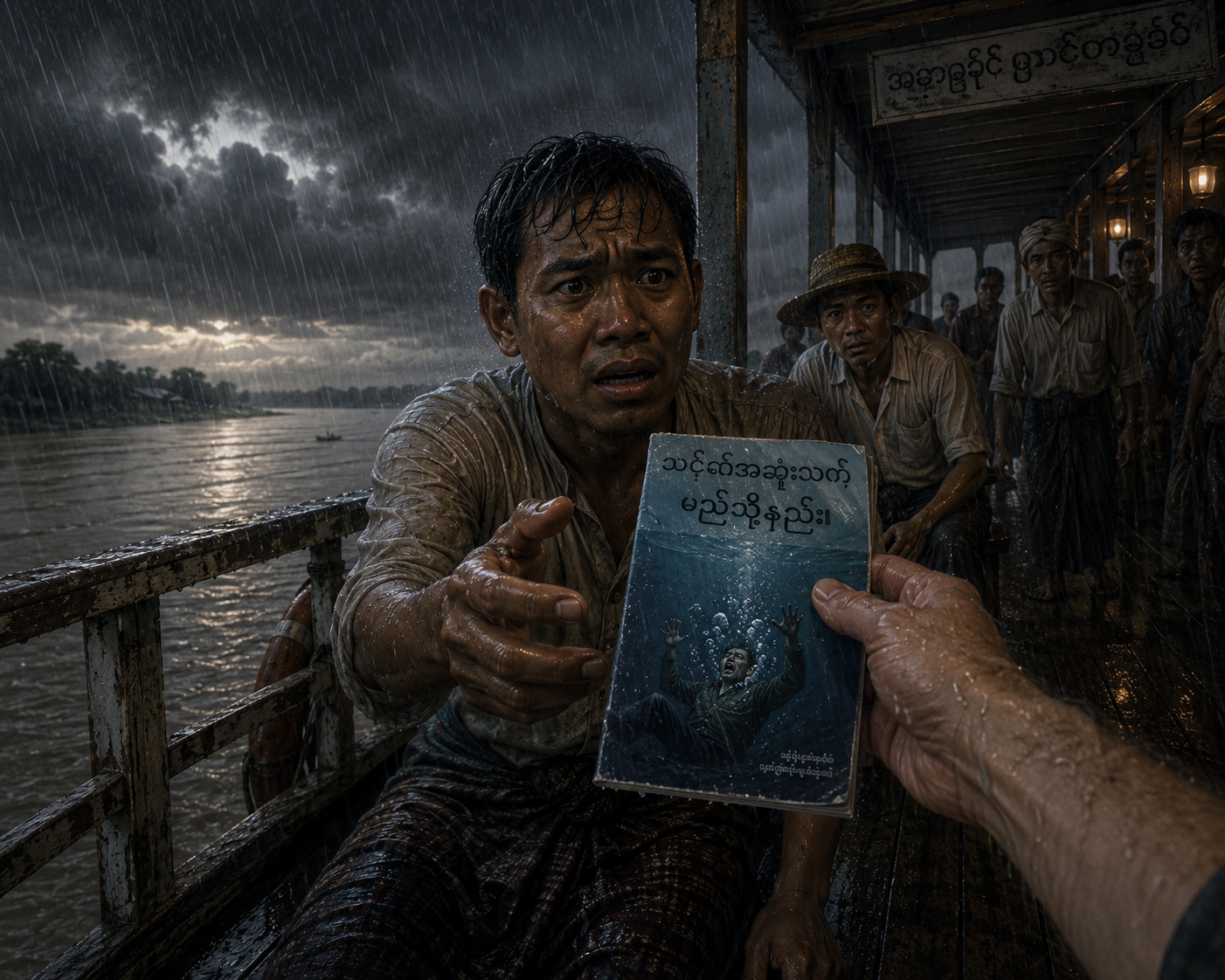
During a gospel trip southwest of Yangon, a group of evangelists were traveling on a boat down the Irrawaddy River when a violent storm suddenly broke out.
One of the evangelists, recalling the story of John Harper—the famous Scottish preacher who shared the gospel with passengers on the sinking Titanic—decided this was a divinely appointed moment. In the middle of the terrifying deluge, he began handing out copies of "The Drowning Man" tract to the Buddhist passengers on board.
He expected the passengers to read the story and find spiritual comfort in the message of a rescuing Savior. He was very wrong.
"The Buddhists on the boat took the distribution of 'The Drowning Man' as a 'bad omen' (ni mak ma kaun bu) that they themselves might be about to drown."
Imagine being on a boat, tossed by a violent river storm, fearing for your life, and someone hands you a pamphlet with a drawing of a person thrashing and drowning in the water. To the terrified passengers, this was not a metaphor for spiritual grace; it was a literal, terrifying prediction of their impending physical doom.
The Contextual Takeaway
Instead of opening the door to a conversation about Jesus, the evangelist's misstep slammed it completely shut.
The story of the Irrawaddy River mishap highlights a profound lesson for anyone engaged in cross-cultural sharing: the medium and the moment are just as important as the message. Encounters across lines of religious difference carry a high potential for misunderstanding because they bring completely different worlds into contact.
You can craft the perfect analogy and find the exact right words to bridge a cultural divide. But if you fail to "read the room"—or in this case, read the weather—your message of rescue might just be received as a terrifying omen of disaster.